
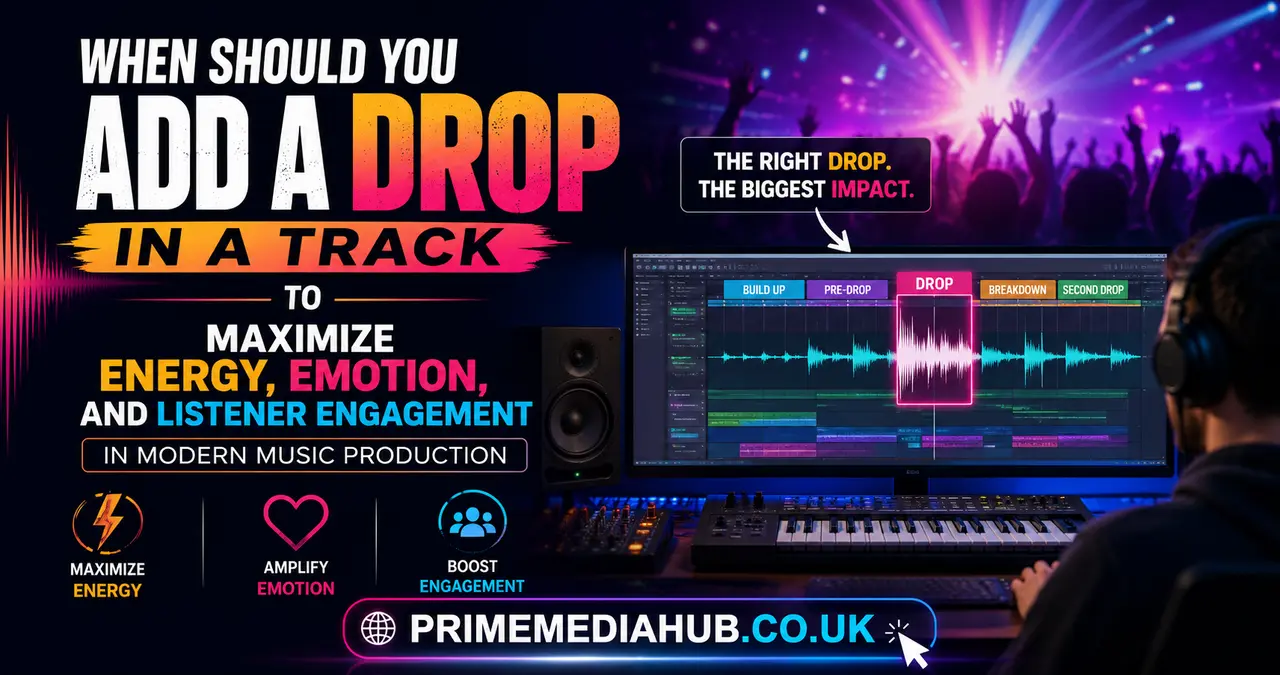
Music production is built around emotional movement. Every section in a track exists for a reason, whether it introduces atmosphere, creates rhythm, builds anticipation, or delivers release. Among all those sections, the drop remains one of the most important moments in modern music. It is the emotional payoff listeners wait for, the moment that transforms tension into excitement and gives a track its identity.
Understanding when should you add a drop in a track is one of the biggest differences between beginner producers and experienced artists. Great drops are not only about loud drums or aggressive basslines. Timing matters just as much as sound design. A perfectly designed drop can still fail if it arrives too early or too late. On the other hand, even a relatively simple drop can feel massive when the buildup and arrangement prepare the listener correctly.
In electronic music, hip-hop, trap, house, dubstep, future bass, techno, and cinematic productions, the drop often becomes the defining moment of the entire arrangement. Audiences remember the release, the impact, and the emotional shift. DJs depend on it to move crowds. Streaming audiences replay tracks because of it. Producers build entire careers around mastering this moment.
The challenge is that there is no universal formula. Every genre, audience, and emotional goal changes the answer slightly. Some tracks demand quick impact. Others require long atmospheric development before release. The key is learning how energy flow works inside a song and recognizing the point where anticipation reaches its peak.
As legendary producer Deadmau5 once said, “The payoff only works when the buildup earns it.” That statement captures the essence of arrangement psychology. The drop only feels satisfying when the listener emotionally needs it.
Modern listeners also consume music differently than they did years ago. Streaming platforms reward strong engagement early in the song. Social media trends encourage memorable moments quickly. Club audiences expect tension and release cycles that keep movement alive on the dance floor. Producers today must balance artistic storytelling with attention retention.
Learning when should you add a drop in a track involves understanding tension, pacing, arrangement structure, emotional storytelling, audience psychology, genre expectations, and sonic dynamics. Once producers understand those elements, drops become more than transitions. They become unforgettable experiences.
Why the Drop Is the Emotional Core of a Track
The drop is often misunderstood as simply the loudest part of a song. In reality, it is the emotional center of the arrangement. Every section before the drop builds toward it, and every section afterward reacts to its impact.
Listeners naturally respond to contrast. Loud feels louder after quiet. Heavy feels heavier after softness. Fast feels faster after slower movement. The drop works because it transforms emotional tension into release. Without tension, there is no payoff. Without contrast, there is no impact.
Many beginner producers make the mistake of starting tracks with maximum intensity immediately. The result usually feels flat because the listener has nowhere emotionally to travel. Great arrangement depends on progression. Energy must rise and fall naturally throughout the song.
A successful drop changes the emotional state of the listener. It can create excitement, aggression, happiness, melancholy, euphoria, or chaos depending on the production style. In dance music, the drop often controls physical movement. In cinematic music, it can signal emotional climax. In trap and bass music, it can redefine rhythmic momentum.
The strongest producers understand that the drop is not isolated from the arrangement. It depends entirely on preparation. Every riser, drum fill, vocal phrase, automation sweep, and silence contributes to how powerful the release feels.
Producer Skrillex once explained this concept perfectly: “Sometimes the best way to make something hit harder is by taking things away first.” That philosophy defines effective buildup design.
When analyzing when should you add a drop in a track, producers should focus less on strict timestamps and more on emotional readiness. The listener should feel anticipation increasing naturally until the release becomes necessary.
The Psychology of Tension and Release in Music
Music functions through emotional expectation. Human brains constantly predict patterns, rhythms, and resolutions. Producers use this instinct to create suspense and payoff.
Tension builds when the arrangement creates uncertainty or anticipation. Release occurs when that tension resolves. The drop represents one of the strongest forms of release in modern music.
Several techniques contribute to tension:
- Rising pitch automation
- Increasing drum density
- Filter sweeps
- White noise risers
- Snare roll acceleration
- Harmonic suspension
- Vocal anticipation
- Temporary bass removal
- Silence before impact
These techniques manipulate listener expectation. The audience subconsciously feels something important approaching.
One reason drops feel powerful is because low frequencies often disappear during the buildup. Removing sub-bass creates physical emptiness. When the bass returns at the drop, the body experiences a strong sense of impact.
Timing matters because emotional tension has limits. If the drop arrives too quickly, listeners may not feel invested enough. If it takes too long, the audience may become impatient or disconnected.
Experienced producers learn how to maintain anticipation without exhausting the listener. They constantly evolve the buildup through automation, variation, and dynamic movement.
The psychology also changes depending on genre. Techno audiences often enjoy long hypnotic builds with subtle release. EDM festival audiences usually expect stronger and faster payoff. Trap listeners may prioritize rhythmic surprise over melodic tension.
Understanding emotional pacing is essential when deciding when should you add a drop in a track because every genre carries different expectations about energy flow.
Common Song Structures and Typical Drop Placement
Although creativity is important, successful tracks often follow recognizable structural patterns. These patterns exist because they align with listener attention spans and emotional rhythm.
Most mainstream electronic tracks place the first drop somewhere between forty-five seconds and one minute fifteen seconds into the song. This timing gives enough room for atmosphere, groove establishment, melodic introduction, and tension building.
More underground genres may delay the drop significantly longer. Club-oriented tracks often include extended intros for DJ mixing purposes.
The table below shows common timing approaches across genres.
| Genre | Typical First Drop Timing | Energy Style | Arrangement Focus |
|---|---|---|---|
| EDM Pop | 0:45–1:00 | Immediate excitement | Hook-driven |
| Future Bass | 0:50–1:15 | Emotional release | Melodic tension |
| Dubstep | 0:45–1:10 | Aggressive impact | Bass energy |
| Trap | 0:40–1:00 | Rhythmic suspense | Percussion focus |
| Tech House | 1:00–2:00 | Groove evolution | Dance flow |
| Techno | 2:00–5:00 | Gradual progression | Atmosphere |
| Drum and Bass | 0:45–1:20 | Fast momentum | Energy continuity |
| Cinematic Electronic | Variable | Storytelling | Emotional climax |
These are guidelines rather than rules. Some iconic tracks intentionally break traditional structure to create surprise.
A shorter buildup can work if the hook is strong and momentum develops quickly. A longer buildup can succeed when the atmosphere remains engaging and dynamic.
Streaming-focused music often favors earlier drops because listener retention matters heavily during the first minute. Club tracks may delay release longer because DJs and dance floors benefit from gradual evolution.
Producers must balance artistic storytelling with audience expectations. That balance strongly affects decisions about when should you add a drop in a track.
Signs Your Track Is Ready for the Drop
One of the most important production skills is recognizing emotional readiness. Many producers continue building tension long after the ideal release point has passed. Others rush the drop before anticipation fully develops.
There are several reliable signs that indicate a track is ready for impact.
The first sign is listener expectation. The audience should subconsciously feel that something major is about to happen. The arrangement creates pressure that demands release.
Another sign involves rhythmic intensity. Build sections often become increasingly active through snare rolls, percussion layering, and rhythmic acceleration. Once rhythmic density peaks, delaying the drop further can weaken impact.
Frequency balance also provides clues. Most build sections remove or reduce low-end frequencies. Once enough anticipation exists, restoring bass frequencies creates emotional and physical release.
Vocal phrasing matters as well. Many successful tracks position the drop immediately after a memorable lyric or emotional vocal moment. This creates continuity between storytelling and energy release.
Automation buildup is another indicator. Filter openings, pitch rises, and increasing stereo width all signal incoming payoff. When those elements reach maximum intensity, the drop should usually follow quickly.
Silence can also reveal readiness. Some producers mute everything for half a beat or a full beat before impact. This brief emptiness dramatically increases anticipation.
Recognizing these signals helps producers determine when should you add a drop in a track without relying entirely on formulaic timing.
Why Some Drops Feel Weak Even With Great Sound Design
Many producers spend countless hours perfecting synths, bass patches, drum layers, and mixing techniques only to discover the drop still lacks impact. In most cases, the problem is not sound quality. It is arrangement context.
A drop cannot feel massive if the buildup does not support it emotionally.
One common mistake is overusing energy before the drop. If the buildup already contains huge drums, full bass, aggressive leads, and maximum loudness, the drop has nowhere to expand emotionally.
Another issue is repetition without progression. Repeating the same riser or snare loop for too long causes listener fatigue. Tension should evolve continuously rather than remain static.
Poor contrast also weakens drops. The audience needs to feel transition. Reducing elements before impact creates room for the release to feel larger.
Mixing problems sometimes contribute as well. Over-compressed masters reduce dynamic range and remove emotional movement. If everything is equally loud, the drop loses power.
Arrangement pacing matters heavily. Some producers extend build sections because they fear the drop is not strong enough. Ironically, delaying release often exposes weaknesses instead of hiding them.
As producer Hans Zimmer once explained regarding cinematic tension, “Expectation is often more powerful than the event itself.” Music production follows the same principle.
The buildup must make listeners emotionally crave the drop. Without that desire, even technically impressive sound design may feel empty.
How Genre Changes Drop Timing Decisions
Different genres use drops differently because audiences expect different emotional experiences.
In EDM festival music, drops often arrive relatively early. Crowds expect immediate energy and recognizable payoff. Long intros can reduce excitement in these environments unless the atmosphere remains extremely engaging.
Future bass focuses heavily on emotional melody. Drops often follow vulnerable vocal sections or cinematic chord progressions. Timing depends more on emotional storytelling than pure aggression.
Dubstep emphasizes impact and rhythmic shock. Producers frequently build intense anticipation through silence, vocal cuts, and aggressive risers before delivering heavy bass movement.
Tech house prioritizes groove consistency over explosive release. Drops may feel more subtle because the goal is sustained dance floor momentum rather than dramatic contrast.
Techno uses gradual progression. Some tracks build tension for several minutes before introducing meaningful changes. The emotional reward often comes from hypnotic evolution rather than sudden explosion.
Trap music relies heavily on rhythmic spacing. Drops may feature minimal melodies but strong percussion and bass movement. Timing usually depends on rhythmic suspense.
Pop productions often shorten intros and accelerate arrangement pacing because mainstream audiences expect faster gratification.
Understanding genre expectations helps producers make smarter arrangement choices. A drop that works perfectly in dubstep might feel excessive in deep house or ineffective in techno.
That is why producers must evaluate when should you add a drop in a track according to audience context rather than universal rules.
The Importance of Listener Attention Span
Modern music consumption habits have changed dramatically over the last decade. Streaming platforms, short-form videos, playlists, and social media clips all influence arrangement decisions.
Listeners now decide extremely quickly whether they will continue playing a song. Producers must capture attention early while still developing emotional buildup properly.
This creates a challenge. Rushing the drop can weaken impact, but delaying it too long may reduce retention.
Successful producers solve this by maintaining engagement during the introduction and buildup. They use evolving melodies, rhythmic movement, vocal hooks, automation, and sonic variation to keep listeners interested before the drop arrives.
A track does not need maximum energy immediately. It simply needs momentum and curiosity.
Some producers introduce smaller “micro-drops” early in the arrangement before the main release later. This technique satisfies attention demands while preserving larger emotional payoff.
Streaming culture has also increased the importance of memorable hooks. Many modern drops contain instantly recognizable melodic or rhythmic signatures designed for replay value.
Attention span considerations matter heavily when deciding when should you add a drop in a track because listener behavior directly affects engagement and retention.
Building a Stronger Buildup Before the Drop
The buildup determines how powerful the drop feels. A weak buildup almost always leads to weak impact regardless of sound design quality.
Great buildups create movement through layering and progression. Every few bars should introduce subtle changes that increase emotional tension.
One effective technique is gradual percussion acceleration. Snare rolls, hi-hat patterns, and rhythmic fills naturally raise excitement levels.
Automation also plays a major role. Filter sweeps, reverb expansion, stereo widening, and pitch rises all contribute to anticipation.
Melodic tension is equally important. Chord progressions that delay harmonic resolution create emotional suspense. Vocal phrases can reinforce expectation before release.
Energy control matters too. Some of the strongest buildups actually remove elements as they progress. Bass disappears. Drums simplify. Space increases. This reduction creates contrast that makes the drop feel enormous.
Silence is another powerful tool. Brief pauses before impact amplify listener anticipation dramatically.
Experienced producers understand that buildup design is psychological rather than purely technical. The audience should feel emotionally pulled toward the release.
Producer Porter Robinson once described emotional arrangement beautifully: “You want listeners to feel like they are falling toward something inevitable.” That sense of inevitability defines effective buildup structure.
How DJs Think About Drops Differently
DJs experience drops differently from casual listeners because they think in terms of crowd energy and transition flow.
A producer creating music for clubs must consider how the track functions inside a live set. DJs often prefer arrangements with enough intro space for mixing and enough tension development to maintain dance floor anticipation.
Drops in club music are not isolated moments. They exist within broader energy arcs across entire sets.
A festival anthem may feature explosive release designed for massive crowd reaction. A warehouse techno track may use subtler transitions that sustain hypnotic movement for long periods.
DJs also pay attention to predictability. Audiences enjoy anticipating the drop together. Shared expectation creates collective excitement.
At the same time, surprising the crowd with unexpected timing can produce unforgettable reactions when executed correctly.
Tracks with excellent drop placement often become DJ favorites because they provide reliable emotional control during performances.
Understanding DJ perspective can help producers better evaluate when should you add a drop in a track intended for live environments.
The Role of Silence Before Impact
Silence is one of the most underrated tools in music production. Many producers fear empty space, but silence can create enormous emotional tension.
A brief pause before the drop increases anticipation because the listener suddenly loses rhythmic grounding. The brain expects immediate resolution.
This technique appears constantly in EDM, dubstep, trap, cinematic music, and modern pop production.
Even half a beat of silence can dramatically increase impact. Some tracks mute everything except vocals or reverb tails before releasing full energy.
Silence works because it interrupts momentum temporarily. That interruption creates emotional suspension.
However, overusing silence can make arrangements predictable. The technique works best when integrated naturally into the buildup.
Timing matters heavily. The silence should feel intentional rather than awkward. If the pause is too long, momentum may collapse.
Used correctly, silence transforms ordinary drops into unforgettable moments.
Why Second Drops Often Matter More Than First Drops
Many producers focus entirely on the first drop and neglect the second half of the arrangement. This is a major mistake.
The second drop often determines whether a track feels replayable or repetitive.
Listeners already know the core idea after the first release. The second drop must evolve while preserving familiarity.
There are many ways to create variation:
- New drum layers
- Additional melodies
- Different bass movement
- Vocal chops
- Rhythmic changes
- Harmonic modulation
- Alternate fills
- Energy expansion
The goal is maintaining excitement without abandoning the original identity.
Some producers intentionally make the first drop simpler and save the largest impact for later. This strategy creates stronger long-term progression.
Second drops also allow emotional storytelling to develop further. The arrangement can become more aggressive, emotional, atmospheric, or chaotic depending on the artistic vision.
Tracks that repeat identical drops without meaningful variation often lose replay value quickly.
Emotional Storytelling Through Drops
The best music tells emotional stories even without lyrics. Arrangement progression functions like narrative pacing in film.
The drop represents climax, transformation, or release within that story.
Melancholic tracks may use drops to express emotional overwhelm. Aggressive bass music may use drops to create controlled chaos. Euphoric festival music may use them to generate collective celebration.
Emotional intention should influence every arrangement decision.
If the track aims for sadness or introspection, the drop may emphasize melody and atmosphere rather than sheer loudness. If the goal is dance floor destruction, rhythmic impact may take priority.
Great producers think emotionally first and technically second.
One reason iconic tracks remain memorable for years is because their drops connect emotionally rather than existing purely as sonic spectacle.
Understanding emotional storytelling helps clarify when should you add a drop in a track because the timing should support narrative progression.
Mistakes Producers Make With Drop Placement
Many common arrangement problems stem from misunderstanding emotional pacing.
One mistake is introducing the drop before establishing musical identity. Listeners need enough context to care about the payoff.
Another issue is endless buildup extension. Some producers keep adding risers and snare rolls because they fear the drop lacks power. Usually this weakens impact instead.
Predictability can also become a problem. If every buildup follows identical timing and structure, listeners lose excitement.
Overcrowded arrangements create another issue. Too many elements competing simultaneously reduce clarity and emotional focus.
Poor dynamic control often weakens drops as well. Excessive loudness compression removes contrast and emotional movement.
Ignoring genre expectations can also hurt effectiveness. A techno audience may appreciate gradual evolution, while mainstream EDM audiences may expect stronger release sooner.
The best producers constantly evaluate arrangement flow from the listener’s perspective rather than focusing only on technical production details.
Using Automation to Increase Drop Impact
Automation is one of the most powerful tools for shaping emotional movement before a drop.
Filter automation gradually opens frequencies and creates increasing brightness. Reverb automation expands perceived space and atmosphere. Stereo widening increases emotional scale.
Volume automation can also create subtle tension. Lowering certain elements before impact makes the drop feel larger when full volume returns.
Pitch automation appears frequently in risers and vocal effects. Rising pitch naturally increases anticipation because the brain associates upward movement with increasing intensity.
Distortion automation can gradually introduce aggression before release.
Professional producers rarely leave buildup sections static. Constant movement keeps listeners engaged and prevents fatigue.
Automation should feel musical rather than random. Every movement should contribute emotionally to the buildup.
How Vocals Influence Drop Timing
Vocals often determine the emotional pacing of a track.
In vocal-driven music, the drop usually follows an emotionally important lyric, phrase, or melodic peak. This creates continuity between storytelling and release.
Some tracks use vocal chops inside the drop itself to maintain melodic identity.
Vocal tension can also extend anticipation. A singer holding a note through the buildup creates emotional suspension that resolves when the drop arrives.
Pop and future bass productions frequently rely on vocals to create emotional connection before impact.
Even in instrumental genres, vocal samples often function as transitional tools leading into the release.
The strongest arrangements treat vocals as emotional guides rather than separate elements.
Why Simplicity Often Creates Bigger Drops
Many beginner producers believe bigger drops require more sounds. In reality, excessive layering often reduces impact.
Simple drops with clear rhythmic focus frequently feel stronger because the listener can process the energy more easily.
Overcomplicated arrangements create frequency masking and emotional confusion.
Professional producers understand the power of restraint. A heavy kick, focused bassline, memorable lead, and strong groove can outperform dozens of competing layers.
Space matters. Silence between sounds creates punch and clarity.
Minimalism also improves groove because rhythmic elements breathe naturally.
Some of the most iconic drops in electronic music rely on surprisingly few core elements.
The Relationship Between Mixing and Drop Energy
Arrangement and mixing work together. Even perfect timing can fail if the mix lacks clarity and dynamics.
Low-end management is especially important. The bass and kick must work together without muddying the mix.
Transient control affects punch. Over-compression can flatten the impact of drums and reduce emotional movement.
Stereo imaging also influences perceived size. Many producers narrow certain buildup elements before expanding width at the drop.
Frequency contrast matters too. Removing low-end during the buildup creates more dramatic release when bass returns.
Dynamic range remains essential. Tracks need movement between quieter and louder moments for drops to feel satisfying.
Professional mixing supports arrangement psychology rather than fighting against it.
Creative Ways to Surprise Listeners With Drops
Predictability is useful because listeners enjoy anticipation, but surprise creates memorability.
Some producers fake out the drop by delaying impact unexpectedly. Others switch rhythms completely when the release arrives.
Tempo changes, genre shifts, halftime transitions, and unexpected melodic variations can create huge emotional reactions.
However, surprise should still feel musically justified. Random chaos usually weakens listener connection.
The best surprises balance familiarity with unpredictability.
A producer might establish one expectation during the buildup and deliver a different but satisfying resolution during the drop.
Creative tension management separates memorable tracks from generic ones.
How Live Audiences React to Different Drop Timings
Live environments reveal arrangement strengths immediately.
Crowds physically respond to tension and release cycles. Experienced DJs can sense when anticipation reaches peak intensity.
Festival audiences often enjoy dramatic builds and explosive drops. Underground club audiences may prefer smoother transitions and groove continuity.
Timing affects physical movement. A perfectly placed drop can trigger synchronized crowd reaction, while poor timing can reduce momentum.
Audience energy also changes throughout a set. Early-night tracks may use slower development, while peak-time tracks often prioritize stronger payoff.
Observing crowd behavior teaches producers valuable lessons about arrangement psychology.
Creating Replay Value Through Effective Drop Placement
Replay value comes from emotional satisfaction combined with anticipation.
Listeners replay tracks because they want to experience the emotional journey again.
A strong drop placement creates addictive tension-release cycles. The audience remembers the payoff and anticipates its return during future listens.
Tracks with poor pacing rarely achieve the same long-term connection.
Variation also matters. Repeated listens should continue revealing subtle details and emotional layers.
Great producers understand that memorable arrangements create emotional habit loops. Listeners become attached to the anticipation itself.
That emotional attachment drives streaming performance, fan loyalty, and cultural longevity.
Conclusion
Understanding when should you add a drop in a track is ultimately about emotional intelligence. Technical skills matter, but arrangement psychology determines whether listeners truly connect with the music.
The best drops feel earned. They arrive at the exact moment anticipation reaches its peak. They transform tension into release while supporting the emotional identity of the track.
Every genre approaches drops differently, but the underlying principles remain consistent. Contrast creates impact. Tension creates desire. Timing creates satisfaction.
Producers who master pacing learn how to guide listeners through emotional journeys instead of simply stacking sounds together. They understand when to build energy, when to remove elements, when to introduce silence, and when to release full intensity.
A great drop is not just heard. It is felt physically and emotionally.
The most memorable music moments happen when arrangement, emotion, sound design, and timing align perfectly. Once producers understand those relationships, they stop guessing about drop placement and start controlling listener experience intentionally.
FAQs
How long should a buildup be before a drop?
The ideal buildup length depends on genre, emotional intention, and audience expectation. In many EDM tracks, buildups last between eight and thirty-two bars. Techno may use much longer progression, while mainstream pop often reaches the drop faster to maintain listener attention.
Can a track have more than one drop?
Yes, many successful tracks feature multiple drops. The second drop often includes additional variation or higher energy to maintain listener excitement and improve replay value.
Why does my drop feel weak even with good sounds?
Weak drops are usually caused by arrangement problems rather than poor sound design. Lack of tension, insufficient contrast, overcrowded mixes, or delayed timing often reduce impact more than synth quality does.
Is there a perfect timestamp for when should you add a drop in a track?
There is no universal timestamp because every genre and arrangement functions differently. However, many modern electronic tracks introduce the first drop between forty-five seconds and one minute fifteen seconds into the song.
Should vocals stop before the drop?
Not always. Some tracks use silence or isolated vocal phrases before impact, while others carry vocals directly into the release. The best choice depends on emotional flow and genre style.
How do DJs prefer drops to be structured?
DJs usually prefer drops that maintain dance floor momentum while providing clear emotional transitions. Club-oriented tracks often include longer intros and carefully paced buildups for easier mixing.
What makes a drop memorable?
Memorable drops combine strong timing, emotional buildup, clear rhythmic identity, impactful sound design, and effective contrast. The listener should feel anticipation before the release arrives.