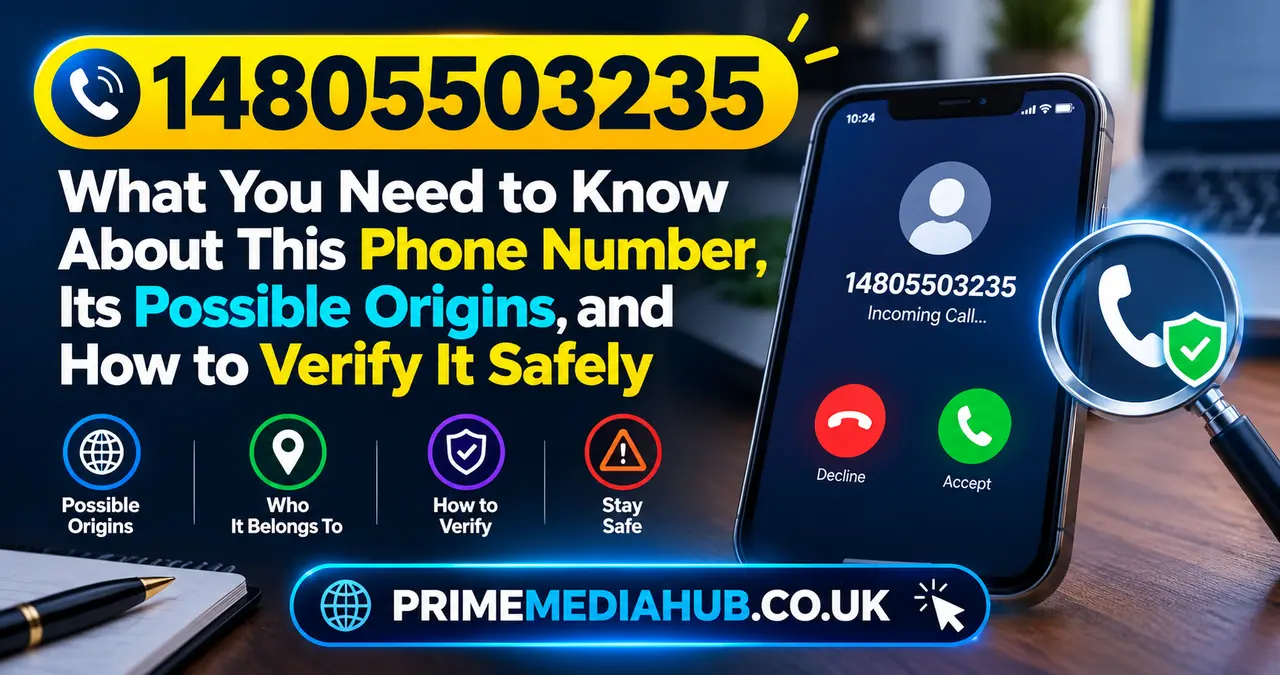
Receiving a call from an unfamiliar number can leave you wondering who is trying to reach you and whether the call deserves your attention. In an age when phone scams, automated marketing calls, and legitimate business communications all compete for our attention, knowing how to evaluate an unknown number is an important part of protecting your privacy.
The number 14805503235 is worth examining carefully before deciding whether to answer, return the call, or block it. However, a phone number alone does not establish the caller’s identity, intentions, or legitimacy. Reliable identification requires examining the number’s format, considering the context of the call, and checking trustworthy sources rather than relying on assumptions.
This guide explains how to investigate 14805503235, understand its possible telephone-number format, recognize suspicious calling behavior, and make an informed decision about what to do next. Whether the call appeared on your mobile phone, came through a messaging application, or appeared in your missed-call history, the same basic principles apply: verify first, protect your personal information, and avoid rushing into a response.
Understanding the Phone Number 14805503235
The first step in investigating 14805503235 is to examine its structure. Telephone numbers follow different numbering plans depending on the country, and the same sequence of digits can have different meanings when written with different international prefixes. Understanding that distinction helps prevent incorrect conclusions about a caller’s location or identity.
If the number is interpreted as a North American Numbering Plan number, it can be formatted as +1 (480) 550-3235. The country calling code +1 is used by the United States, Canada, and several other participating regions, while area code 480 is associated with Arizona, particularly communities in the Phoenix metropolitan area. This interpretation is plausible based on the digits, but it does not independently verify that the number is currently assigned, active, or genuinely associated with a caller in Arizona.
There is an important difference between a number’s apparent origin and the actual location of the person calling. Mobile phones, internet-based calling services, business telephone systems, and number portability can all complicate geographic identification. Caller ID can also be spoofed, meaning a caller deliberately makes another number appear on the recipient’s screen.
For that reason, 14805503235 should be treated as an unidentified number until reliable evidence establishes more information. Its formatting may provide a useful starting point, but it is not proof of ownership, business affiliation, or trustworthiness.
What Could a Call From 14805503235 Mean?
An unfamiliar call can have several ordinary explanations. It might come from a customer service representative, a business following up on an inquiry, a delivery company, a healthcare provider, or an individual attempting to reach someone who previously used the number. Organizations also sometimes use third-party telephone systems that display numbers unfamiliar to their customers.
Another possibility is an unwanted sales call, a survey, an automated message, or a scam attempt. Fraudulent callers may pretend to represent banks, government agencies, technical support departments, or well-known companies. They may claim that an account is compromised, a payment is overdue, or an urgent action is required.
At present, the digits alone do not establish which of these explanations applies to 14805503235. Without a verified directory listing, reliable carrier information, or credible reports tied to the number, it would be misleading to identify a particular person or company as the caller.
The most useful evidence comes from the circumstances surrounding the call. Did the caller leave a detailed voicemail? Did they identify an organization that can be independently contacted? Did they request sensitive information, demand payment, or pressure you to act immediately? These details often provide more practical insight into the risk than the number itself.
As a general rule, legitimate callers should be able to explain the purpose of their communication without demanding passwords, one-time verification codes, or immediate payment through unusual methods.
How to Check Whether 14805503235 Is Legitimate
A careful lookup can help you decide whether to return a call. Begin by searching the full number in several formats, including 14805503235, +14805503235, and 480-550-3235. Different directories and websites use different formatting conventions, so searching multiple versions can uncover relevant results that a single query might miss.
Look for information from established business directories, official company websites, and reputable caller-reporting services. If a search result claims that the number belongs to a particular organization, visit that organization’s official website independently. Compare the contact details rather than trusting the information presented by an unsolicited caller.
Reverse phone lookup websites can sometimes provide useful clues, including the general number type, possible carrier, or user-submitted spam reports. However, their records may be incomplete, outdated, or inaccurate. A website displaying a name beside 14805503235 does not necessarily prove that the named person currently controls the number.
The following table summarizes common verification methods and their limitations.
| Verification method | What it may reveal | Important limitation |
|---|---|---|
| Search engine lookup | Public listings, business references, and reported calls | Search results may be outdated or unrelated |
| Reverse phone lookup | Possible number type, carrier, or directory information | Ownership information may be incomplete |
| Official company website | Published customer service numbers and contact details | A displayed caller ID can be spoofed |
| Voicemail review | The caller’s stated purpose and callback information | Scammers can leave convincing messages |
| Mobile phone spam detection | Automated warnings and community reports | False positives and missed detections are possible |
| Telephone service provider | Available call-screening or abuse-reporting options | The provider may not disclose subscriber identity |
| Independent callback | Whether a claimed organization recognizes the communication | Use a trusted number obtained independently |
A practical verification process should combine more than one source whenever the call involves money, account access, or sensitive personal information. If no credible information connects 14805503235 to a known organization, there is no need to return the call simply to satisfy curiosity.
Recognizing Potential Phone Scams and Spam Calls
Scam calls often rely on urgency, fear, or excitement. A caller might claim that your bank account will be frozen, that a package cannot be delivered, or that you have won a prize requiring an upfront fee. These tactics encourage people to respond emotionally rather than verify the facts.
Another warning sign is a request for information that a legitimate representative should not need over an unsolicited call. Examples include a password, a complete payment card security code, a one-time authentication code, or remote access to a computer. Fraudsters may also request cryptocurrency transfers, gift cards, or payments through unfamiliar applications because those transactions can be difficult to reverse.
A suspicious call does not automatically prove that 14805503235 is a scam number. It is essential to distinguish between a general warning about fraudulent calling practices and a verified report about a specific telephone number. No reliable conclusion about this number’s reputation should be drawn without supporting evidence.
Consider a simple example. Someone calls and claims to be from a bank, stating that an unusual transaction requires immediate verification. Instead of answering the caller’s questions, end the call and use the telephone number printed on your bank card or published on the bank’s official website. If the alert is genuine, the bank should be able to explain the situation through its verified communication channels.
The Federal Trade Commission provides useful information about recognizing and avoiding phone scams. Its guidance is valuable because it focuses on suspicious behavior, verification, and consumer protection rather than assuming that a particular area code is inherently dangerous.
What to Do If 14805503235 Calls Repeatedly
Repeated calls from an unknown number can become disruptive, particularly when they occur early in the morning, late at night, or several times within a short period. Before responding, review your call history and determine whether the calls appear to follow a pattern. Note the dates, times, frequency, and any voicemail messages.
If the calls are unwanted, your phone’s built-in call-blocking features may offer a straightforward solution. Most modern smartphones allow users to block individual numbers, silence unknown callers, or enable warnings for suspected spam. The exact settings vary by device and operating system.
Blocking 14805503235 can reduce interruptions from that displayed number, but it may not stop someone who uses multiple numbers or spoofs caller ID. For persistent harassment, threatening communications, or repeated suspected fraud, retain relevant records and contact your mobile carrier. Depending on your location and the nature of the incident, a consumer-protection agency or law-enforcement authority may also be appropriate.
Avoid calling back repeatedly just to find out who is responsible. Some unwanted calls are designed to encourage engagement, confirm that a number is active, or persuade the recipient to reveal personal details. When a call has no credible explanation and no useful voicemail, ignoring it is often a sensible choice.
The objective is not to determine the caller’s identity at any cost. It is to protect your time, personal information, and financial security while leaving a reasonable opportunity for legitimate communications to reach you.
Protecting Your Personal Information When Answering Unknown Calls
Your personal information is valuable, and an unsolicited telephone conversation can create opportunities for social engineering. A caller may begin with seemingly harmless questions about your name, address, workplace, or recent purchases. Individually, those details may appear insignificant, but together they can help a fraudster construct a convincing identity or target a future attack.
When answering an unfamiliar call, avoid confirming sensitive information before establishing who is speaking and why. If the caller claims to represent a company, ask for the department’s name and a reference number, then verify the information independently. Do not rely exclusively on a telephone number, logo, caller ID label, or official-sounding introduction.
Be especially cautious with authentication codes. A one-time code sent to your phone may be intended to authorize a login, reset a password, or approve a financial transaction. Someone who asks you to read that code aloud could be attempting to access an account, even if they claim to be helping you secure it.
There is also no need to install software, share your screen, or grant remote access because an unknown caller insists that your device has a problem. If you suspect a genuine technical issue, contact the device manufacturer or service provider using a trusted channel.
These precautions are useful regardless of whether the displayed number is 14805503235 or another unfamiliar sequence. A secure approach focuses on the caller’s verifiable identity and behavior instead of making a decision based only on the number.
Why Reverse Phone Lookup Results Are Not Always Reliable
Reverse phone lookup services can be helpful, but their results require careful interpretation. Some services rely on public records, telephone directories, commercial databases, and information submitted by users. Others may display estimates or information that has not been recently verified.
A number may also have been reassigned to a new subscriber. A business might change providers, an individual might transfer a number between carriers, or a voice-over-internet service might allow calls to originate from locations different from the number’s original geographic association. These changes can leave older directory entries inaccurate.
Crowdsourced spam reports have similar limitations. If several users report repeated calls from a number, that pattern may be worth investigating, but individual reports do not always distinguish between legitimate calls, mistaken identification, and malicious activity. A genuine business can receive negative reports because of aggressive sales practices, while a fraudulent caller using spoofed information may generate complaints associated with an innocent subscriber.
When researching 14805503235, look for consistency across independent sources. Recent reports with specific explanations are generally more informative than an isolated comment that simply labels a number as dangerous. Likewise, a lack of complaints does not establish that a call is safe, particularly if the number is new or rarely used.
A useful principle is to treat lookup results as evidence to evaluate rather than final judgments. Combine them with the content of the call, the caller’s requests, and information from official sources before deciding how to proceed.
Common Questions About 14805503235
Who owns 14805503235?
The owner of 14805503235 cannot be reliably identified from the digits alone. A reverse lookup might reveal a public business listing or other directory information, but such records should be independently verified. Telephone subscriber information may also be private or unavailable through public sources. If the caller claims to represent an organization, contact that organization through its officially published telephone number to establish whether the communication is genuine.
Is 14805503235 a scam number?
There is insufficient verified evidence here to classify 14805503235 as either a scam number or a legitimate business number. A reliable assessment requires current information, such as credible complaint records, a verified business listing, or evidence of suspicious behavior during the call. Treat unexpected requests for passwords, verification codes, money transfers, or immediate action as warning signs regardless of the number displayed on your phone.
Where does 14805503235 originate?
When interpreted as a North American number, the sequence can be formatted as +1 (480) 550-3235. The +1 country code is used across the North American Numbering Plan, and area code 480 serves parts of Arizona, including the Phoenix metropolitan area. This format suggests a possible association with that numbering region, but it does not establish the caller’s current physical location or prove that the displayed number has not been spoofed.
Should I call 14805503235 back?
You generally do not need to return an unfamiliar call unless there is a credible reason to do so. First, check whether the caller left a voicemail, whether you are expecting a call, and whether a trusted directory identifies a relevant organization. If the caller claims to represent a bank, government agency, or company, obtain the organization’s contact details independently. Avoid returning calls that involve threats, unusual payment demands, or pressure to provide confidential information.
How can I block 14805503235 on my phone?
On most smartphones, you can open your recent calls, select the unfamiliar number, and choose the available option to block it or report it as spam. Menu names vary between Android devices, iPhones, and mobile network providers. If calls continue from different numbers, consider enabling spam filtering or call screening through your device or carrier. Keep records of repeated unwanted calls if they involve harassment, threats, or suspected fraud.
Can a caller using 14805503235 see my personal information?
Receiving a call alone does not automatically give the caller access to your contacts, messages, photographs, passwords, or other information stored on your phone. However, information you disclose during a conversation may be used for impersonation or targeted fraud. Do not share authentication codes, passwords, financial details, or sensitive identity information with an unverified caller. If you have already disclosed confidential information, secure the affected accounts and contact the relevant financial institution or service provider promptly.
What should I do if I accidentally shared information with the caller?
The appropriate response depends on what you disclosed. If you shared a password, change it immediately and review recent account activity. If you provided a one-time authentication code, check the associated account for unfamiliar logins and revoke suspicious sessions where possible. If you shared financial details, contact your bank or payment provider through an official channel. If you installed software or granted remote access at the caller’s request, disconnect the session, remove unauthorized access, and seek trusted technical assistance. Acting quickly can reduce the risk of further harm.
Conclusion: How to Make an Informed Decision About 14805503235
Investigating an unfamiliar telephone number is less about finding an instant answer and more about separating reliable evidence from assumptions. Although 14805503235 can plausibly be formatted as a North American number associated with area code 480 in Arizona, that information alone does not reveal who called, why they called, or whether the communication is legitimate.
The most effective approach is to search for the number in multiple formats, review credible public listings, assess the content of any voicemail, and independently verify any organization the caller claims to represent. Be cautious about reverse lookup services that promise definitive identities without explaining their sources, and do not treat the absence of spam reports as proof of safety.
If 14805503235 repeatedly contacts you without a clear purpose, blocking the displayed number and enabling call screening are reasonable options. If the caller requests sensitive information, threatens you, or demands unusual payments, avoid engaging and report the incident through the appropriate channels.
Ultimately, the safest decision comes from verified information rather than guesswork. Stay alert, protect your personal details, and remember that a legitimate caller should allow you enough time to verify their identity before you take action.
For additional guidance on identifying suspicious calls and protecting yourself from fraud, consult the Federal Trade Commission’s official consumer advice on phone scams, which explains common warning signs and practical steps for handling unexpected communications.
Explore latest insights: 47429319830