
Introduction
The demand for faster data transmission continues to grow across modern digital infrastructure. Cloud computing, artificial intelligence workloads, streaming platforms, enterprise applications, and hyperscale data centers all require network solutions that can handle enormous volumes of traffic without compromising reliability. As organizations continue to scale their operations, traditional networking technologies often struggle to keep up with the increasing need for bandwidth and efficiency.
This is where 400G QSFP-DD has become one of the most important innovations in optical networking. Designed to support extremely high-speed data transmission while maintaining a compact form factor, 400G QSFP-DD enables network operators to increase capacity without significantly expanding hardware footprints. It combines performance, flexibility, and scalability in a way that aligns with the requirements of modern infrastructure.
The growing adoption of 400G QSFP-DD across data centers, telecom networks, and cloud environments demonstrates its importance in the networking ecosystem. Organizations looking to future-proof their infrastructure often consider this technology a strategic investment because it delivers both immediate performance improvements and long-term scalability benefits.
“Modern networks are no longer measured only by speed. They are measured by how efficiently they scale, adapt, and support future growth. This is exactly where 400G QSFP-DD stands out.”
Understanding 400G QSFP-DD
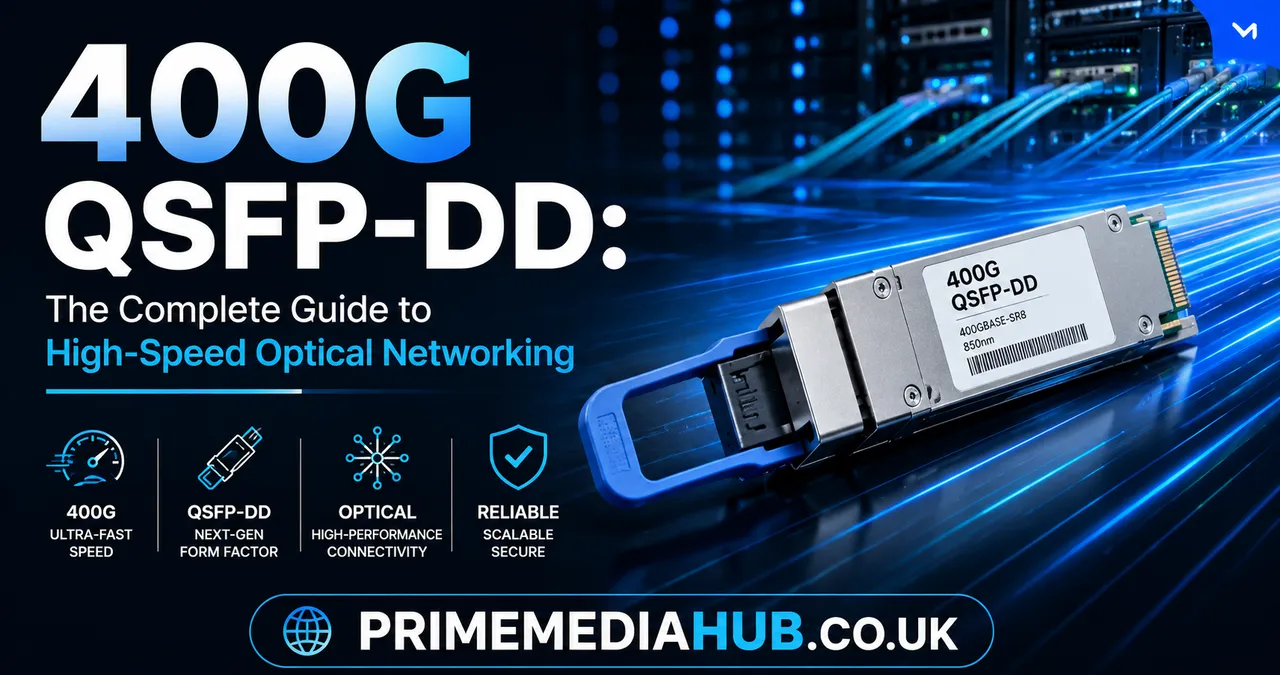
The term 400G QSFP-DD refers to a high-speed transceiver form factor capable of supporting four hundred gigabits per second of data transmission. QSFP-DD stands for Quad Small Form-factor Pluggable Double Density. The double-density design allows the module to provide significantly higher bandwidth while maintaining compatibility with many existing networking environments.
One of the primary reasons for the popularity of 400G QSFP-DD is its balance between performance and practicality. Network engineers often seek solutions that deliver more bandwidth without requiring a complete redesign of existing infrastructure. The QSFP-DD architecture helps achieve this objective by maximizing port density while preserving operational flexibility.
Another important aspect is interoperability. Many vendors support 400G QSFP-DD, making it easier for organizations to integrate the technology into multi-vendor environments. This flexibility has contributed significantly to widespread industry adoption and continued market growth.
The design of 400G QSFP-DD also supports various transmission distances and deployment scenarios. Whether the requirement involves short-reach data center connections or longer-distance network links, suitable transceiver options are available to meet specific operational needs.
The Evolution of High-Speed Networking
Networking technology has evolved rapidly over the years. As internet usage expanded and enterprise applications became increasingly data-intensive, bandwidth requirements grew at an unprecedented pace. Organizations that once relied on lower-speed connections eventually faced challenges related to congestion, latency, and scalability.
The development of high-capacity optical transceivers represented a major milestone in addressing these challenges. Earlier technologies delivered substantial improvements, but continued growth in cloud computing and digital services created a need for even greater bandwidth. 400G QSFP-DD emerged as a response to these changing requirements.
Modern data centers process massive amounts of information every second. Virtualization, machine learning, analytics platforms, and distributed applications generate continuous traffic flows that demand high-performance networking solutions. 400G QSFP-DD enables these environments to maintain efficiency while supporting increasing workloads.
As businesses continue to embrace digital transformation, the role of advanced optical networking technologies becomes even more critical. The evolution toward faster and more intelligent networks places 400G QSFP-DD at the center of many infrastructure modernization strategies.
Key Features of 400G QSFP-DD
One of the most attractive characteristics of 400G QSFP-DD is its exceptional bandwidth capacity. By delivering four hundred gigabits per second, it significantly increases network throughput compared to earlier generations of optical transceivers. This improvement allows organizations to manage growing traffic demands more effectively.
Another major feature is high port density. The double-density connector design enables network operators to maximize switch and router utilization. This approach reduces space requirements while improving overall infrastructure efficiency. In environments where rack space is valuable, such optimization can provide substantial operational benefits.
Power efficiency is another important advantage. Although high-speed networking naturally requires energy consumption, modern 400G QSFP-DD modules are engineered to optimize performance while minimizing power usage. This balance helps organizations control operational costs and improve sustainability initiatives.
Reliability also plays a critical role. Network downtime can result in significant financial and operational consequences. 400G QSFP-DD solutions are designed to deliver stable performance under demanding conditions, making them suitable for mission-critical applications.
Architecture Behind 400G QSFP-DD
The architecture of 400G QSFP-DD is designed to support high-speed transmission through multiple electrical and optical lanes. This approach enables efficient data distribution while maintaining signal integrity across complex networking environments.
A key component of the architecture is the double-density electrical interface. By increasing the number of electrical contacts compared to traditional designs, 400G QSFP-DD achieves significantly greater bandwidth capacity. This innovation allows organizations to scale network performance without dramatically increasing hardware complexity.
Signal processing technologies also play an important role. Advanced digital signal processing techniques help maintain data accuracy and transmission quality, even at extremely high speeds. These capabilities are essential for ensuring consistent network performance.
The modular nature of 400G QSFP-DD further enhances deployment flexibility. Organizations can select appropriate transceiver variants based on distance requirements, fiber types, and network architectures. This adaptability contributes to widespread industry adoption.
Benefits of Deploying 400G QSFP-DD
Organizations adopting 400G QSFP-DD often experience immediate improvements in network capacity. Higher bandwidth enables greater traffic handling capabilities, reducing congestion and supporting better application performance.
Scalability represents another significant advantage. As business requirements evolve, network infrastructure must accommodate increasing demands. 400G QSFP-DD provides a scalable foundation that supports future expansion without requiring frequent hardware upgrades.
Cost efficiency is also an important consideration. While initial deployment investments may be substantial, the long-term benefits often justify the expenditure. Consolidated infrastructure, improved resource utilization, and enhanced operational efficiency contribute to a favorable return on investment.
Enhanced user experiences are another outcome. Faster and more reliable network performance supports improved application responsiveness, smoother data transfers, and better service delivery across digital platforms.
Common Applications of 400G QSFP-DD
The most prominent application of 400G QSFP-DD is within hyperscale data centers. These environments require enormous bandwidth capacity to support cloud services, storage platforms, and distributed computing workloads.
Telecommunications providers also benefit significantly from 400G QSFP-DD deployments. High-capacity backbone networks rely on advanced optical technologies to accommodate increasing traffic volumes generated by consumers and businesses.
Enterprise organizations increasingly adopt 400G QSFP-DD as part of modernization initiatives. Large corporations often manage complex digital ecosystems that demand reliable, high-performance connectivity across multiple locations.
Research institutions and scientific organizations represent another important user group. Advanced computing environments frequently process large datasets that require rapid transmission between storage and computing resources. The capabilities of 400G QSFP-DD make it particularly valuable in such scenarios.
Comparison Between 400G QSFP-DD and Other Form Factors
| Feature | 400G QSFP-DD | Traditional QSFP | Alternative High-Speed Modules |
|---|---|---|---|
| Bandwidth Capacity | Very High | Moderate | High |
| Port Density | Excellent | Good | Good |
| Scalability | Excellent | Limited | Strong |
| Industry Adoption | Extensive | Established | Growing |
| Future Readiness | Strong | Moderate | Strong |
One of the main differences is bandwidth capacity. 400G QSFP-DD delivers significantly greater throughput compared to many earlier technologies. This capability makes it particularly suitable for modern network environments experiencing rapid traffic growth.
Port density also distinguishes 400G QSFP-DD from several alternatives. Organizations seeking to maximize infrastructure efficiency often favor solutions that provide higher capacity within limited physical space.
Compatibility considerations vary depending on specific deployment requirements. However, the broad industry support for 400G QSFP-DD has contributed to its position as a preferred option for many network operators.
Compatibility and Integration Considerations
Before implementing 400G QSFP-DD, organizations should evaluate compatibility with existing infrastructure. Although the technology is designed to support flexible deployment scenarios, careful planning remains essential.
Network switches, routers, and cabling systems should be assessed to ensure support for required performance levels. Compatibility verification helps avoid unexpected integration challenges and supports smoother deployment processes.
Vendor interoperability is another important factor. Many enterprises operate multi-vendor environments where seamless communication between components is critical. Fortunately, widespread adoption of 400G QSFP-DD has encouraged strong interoperability across numerous platforms.
Testing and validation procedures can further improve deployment outcomes. Comprehensive evaluation helps identify potential issues before production implementation, reducing operational risks and supporting long-term reliability.
The Role of 400G QSFP-DD in Cloud Infrastructure
Cloud computing environments depend heavily on efficient networking. Massive amounts of data move continuously between servers, storage systems, and end users. 400G QSFP-DD helps cloud providers meet these demands by delivering exceptional bandwidth and reliability.
As cloud adoption continues to expand, infrastructure providers must support increasing workloads without sacrificing performance. The scalability of 400G QSFP-DD aligns closely with these objectives, enabling efficient growth strategies.
Another advantage is improved resource utilization. High-capacity networking reduces bottlenecks and supports better workload distribution across cloud environments. This efficiency contributes to enhanced service quality and operational performance.
The ability to support emerging technologies further strengthens the value of 400G QSFP-DD within cloud ecosystems. Artificial intelligence, big data analytics, and advanced automation platforms all benefit from high-speed connectivity.
Power Efficiency and Sustainability
Energy efficiency has become a major consideration in network design. Organizations increasingly seek technologies that balance performance with environmental responsibility. 400G QSFP-DD addresses this challenge through optimized engineering and advanced component design.
Efficient power utilization contributes to lower operational costs. In large-scale deployments, even modest reductions in energy consumption can produce significant financial benefits over time.
Sustainability initiatives also benefit from efficient networking technologies. Many enterprises have established environmental goals that require improvements in infrastructure efficiency. The adoption of 400G QSFP-DD can support these objectives while maintaining high performance standards.
Reduced hardware requirements further contribute to sustainability efforts. By increasing capacity within compact form factors, organizations can achieve greater efficiency without extensive physical expansion.
Deployment Best Practices
Successful deployment of 400G QSFP-DD begins with careful planning. Organizations should evaluate current network performance, identify future growth requirements, and establish clear implementation objectives.
Capacity planning plays a critical role. Understanding traffic patterns and projected demand helps ensure that deployed infrastructure delivers optimal value and performance.
Proper testing procedures are equally important. Pilot deployments and validation processes can identify configuration issues before widespread implementation. This proactive approach minimizes disruptions and supports smoother transitions.
Ongoing monitoring should also be part of deployment strategy. Continuous performance analysis enables organizations to optimize operations and quickly address potential concerns.
Future Outlook for 400G QSFP-DD
The future of networking will continue to be defined by increasing data volumes and expanding digital services. As organizations adopt more advanced technologies, demand for high-capacity connectivity will remain strong.
400G QSFP-DD is expected to play a significant role in supporting this evolution. Its combination of performance, scalability, and compatibility positions it as a critical component of modern infrastructure strategies.
Emerging applications such as artificial intelligence, edge computing, and advanced analytics will further increase bandwidth requirements. The capabilities of 400G QSFP-DD align well with these trends, supporting continued relevance in the years ahead.
Industry investment and ongoing innovation suggest that the ecosystem surrounding 400G QSFP-DD will continue to mature. This development will provide organizations with even greater flexibility and deployment options.
Frequently Asked Questions
What is 400G QSFP-DD?
400G QSFP-DD is a high-speed optical transceiver form factor designed to deliver four hundred gigabits per second of network bandwidth. It is widely used in data centers, cloud infrastructure, and telecommunications networks.
Why is 400G QSFP-DD important?
It provides the bandwidth, scalability, and efficiency required to support modern digital workloads. Organizations use it to improve network performance and prepare for future growth.
Where is 400G QSFP-DD commonly used?
It is commonly deployed in hyperscale data centers, cloud computing environments, enterprise networks, telecommunications infrastructure, and research facilities.
Is 400G QSFP-DD compatible with existing infrastructure?
Compatibility depends on the specific networking equipment being used. Many modern switches and routers support 400G QSFP-DD, making integration relatively straightforward.
What are the advantages of 400G QSFP-DD?
Key advantages include high bandwidth capacity, excellent port density, scalability, operational efficiency, reliability, and support for future networking requirements.
Does 400G QSFP-DD improve data center performance?
Yes. By increasing throughput and reducing bottlenecks, 400G QSFP-DD helps data centers process larger volumes of traffic more efficiently.
How does 400G QSFP-DD support cloud computing?
It provides the high-speed connectivity needed to transfer large amounts of data between servers, storage systems, and applications within cloud environments.
Is 400G QSFP-DD suitable for future networking needs?
Yes. Its architecture is designed to support growing bandwidth demands, making it a strong choice for organizations planning long-term infrastructure investments.
Conclusion
400G QSFP-DD has become a cornerstone technology in modern networking because it delivers exceptional bandwidth, scalability, efficiency, and reliability. From hyperscale data centers to cloud platforms and enterprise environments, it enables organizations to meet growing performance demands while preparing for future expansion. As digital transformation continues to accelerate, 400G QSFP-DD will remain a vital solution for building faster, smarter, and more resilient network infrastructures.